On a chilly morning in early January, Renee Nicole Good, a 37-year-old mother of three, went about her daily routine in her Minneapolis neighborhood, unaware that the day would end in tragedy.
Good, described by neighbors and friends as compassionate, devoted to her children, and deeply involved in her community, was confronted by officers from Immigration and Customs Enforcement (ICE) during a routine operation.
Authorities later stated that the encounter escalated when Good allegedly attempted to flee in her vehicle. Video footage circulated online showing her car moving toward an ICE agent during the confrontation.
In the moments that followed, the officer discharged his firearm, resulting in Good’s death. While local authorities initially cited the officer’s perception of immediate danger as justification, the incident immediately sparked widespread concern, debate, and outrage.
Friends and family of Good painted a starkly different picture of her final moments. They described her as cautious, family-oriented, and committed to her children’s well-being.
Her death was felt acutely in Minneapolis, particularly among her close-knit community, where she was seen as a nurturing presence.
Public grief intensified as her story was shared widely through social media and local news outlets, emphasizing both the human cost of federal enforcement actions and the broader systemic questions surrounding ICE operations.
National Reactions and Polarization
News of Renee Good’s death quickly spread beyond Minneapolis, drawing attention from media, activists, and public officials nationwide.
Social media became a battleground of opinion, with posts ranging from memorial tributes to critiques of federal law enforcement policies.
Supporters of Good highlighted perceived racial disparities in law enforcement use of force, emphasizing that Black and brown communities are disproportionately affected by aggressive policing and immigration enforcement actions.
Conversely, defenders of the ICE agent involved emphasized the dangers officers face during field operations. Many highlighted the fact that ICE officers often encounter unpredictable situations, sometimes involving individuals with prior criminal histories or behaviors that may pose immediate threats.
Proponents argued that the agent acted in accordance with training under a perceived threat, highlighting the inherent split-second decision-making that law enforcement personnel must make in high-stakes scenarios.
This polarization was not confined to social media. Local demonstrations erupted in Minneapolis, some peaceful and others escalating into confrontations with law enforcement.
National politicians, commentators, and advocacy groups weighed in, emphasizing different priorities: some focused on officer safety, others on accountability, and still others on reforming immigration enforcement practices. The debate underscored the tension between enforcing federal laws and ensuring community trust and safety.
Bill Ackman’s Controversial Donation
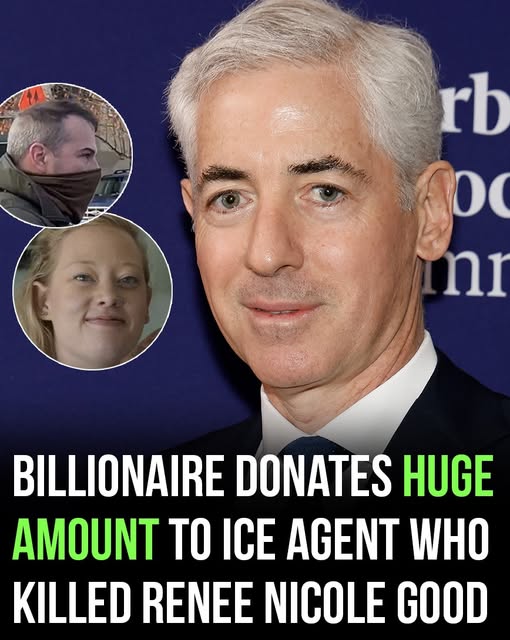
In the midst of this heated national debate, billionaire hedge-fund manager Bill Ackman made headlines. Ackman contributed $10,000 to a GoFundMe campaign supporting Jonathan Ross, the ICE agent involved in the fatal encounter.
Ackman publicly explained that his donation stemmed from a commitment to the principle of legal due process: the idea that individuals are presumed innocent until proven guilty.
Ackman clarified that he had originally intended to contribute to the fundraising effort for Renee Good’s family but discovered the campaign had already closed after surpassing its goal.
His contribution quickly became a focal point for national discourse. Supporters of Ackman argued that his action was consistent with the principles of fairness and legal protection for all individuals, including law enforcement personnel under scrutiny.
Critics, however, viewed the donation as a symbolic endorsement of a system that too often justifies lethal force against marginalized communities, particularly Black and brown individuals.
The donation ignited debate over the role of high-profile philanthropists in polarizing public events.
While Ackman’s stated intent was to support due process, public perception varied widely, illustrating the challenges wealthy individuals face when making contributions in politically charged or emotionally sensitive contexts.
Fundraising Campaigns and Public Grief
Parallel to Ackman’s contribution, a separate GoFundMe campaign for Renee Good’s family raised more than $1.5 million.
Thousands of small donors contributed, emphasizing collective grief and concern for the well-being of Good’s children. Supporters highlighted her character, emphasizing her devotion as a mother, her community involvement, and the personal loss felt by those who knew her.
The ICE agent’s fundraising campaign, meanwhile, drew criticism for its language and framing, with some observers arguing that it conflicted with platform policies related to supporting individuals involved in violent incidents.
Legal analysts noted that while providing financial support for legal defense is not inherently prohibited, the public perception of such campaigns can affect broader discourse on justice, accountability, and systemic reform.
The contrast between the two fundraising campaigns became emblematic of the broader societal debate: one focused on loss, mourning, and systemic critique; the other on legal support, officer safety, and due process.
Both campaigns highlighted how public contributions, amplified by social media, can become symbolic, influencing narratives far beyond their immediate purpose.
Protesters march against ICE after an immigration agent shot and killed 37-year-old Renee Nicole Good in her car in Minneapolis, in New York City, January 8. REUTERS/Eduardo Munoz
Media Coverage and Social Discourse
The media’s role in shaping public understanding was pronounced. Mainstream outlets reported on the incident, the video footage, the officer’s prior history, and community reactions.
Simultaneously, social media amplified immediate reactions, often blurring the lines between verified facts, speculation, and opinion.
Analysts have emphasized that in high-profile cases, the interplay of traditional media and social platforms creates a complex information environment. Public understanding is influenced not only by factual reporting but also by emotional resonance, viral content, and polarized framing.
In this case, videos of the incident circulated alongside tributes to Good and analyses of the officer’s actions, producing a multifaceted narrative with multiple competing interpretations.
Historical Context and Systemic Concerns
The incident also brought renewed attention to longstanding discussions about federal law enforcement, immigration enforcement practices, and the use of force in the United States.
Advocates for reform pointed out historical trends in which marginalized communities have been disproportionately affected by aggressive policing and enforcement practices.
These critics emphasize the need for policy changes, including stricter oversight, clearer use-of-force protocols, and improved accountability mechanisms.
At the same time, supporters of ICE highlight the agency’s complex mission, which includes enforcing federal immigration laws while protecting public safety. Officers often operate in challenging, high-risk environments, where rapid decision-making can mean the difference between life and death.
The Minneapolis incident serves as a case study in these inherent tensions, illustrating the difficulty of balancing operational necessity with ethical, legal, and societal considerations.
Following the incident, political leaders from across the spectrum weighed in. Republicans and administration officials emphasized the dangerous realities faced by federal agents, framing the shooting as a tragic but defensible act in line with law enforcement training.
Some conservative commentators underscored the risks of public scrutiny leading to “second-guessing” officers in the field, which could compromise operational safety.
Democrats and progressive advocacy groups, in contrast, stressed the need for accountability and systemic reform. They called for independent investigations, revisions to ICE use-of-force protocols, and closer oversight of federal enforcement operations.
Lawmakers raised concerns about racial and socio-economic disparities in enforcement practices, highlighting that such incidents often disproportionately impact Black and brown communities.
The polarized political response reflected deeper national tensions over immigration, public safety, and the role of federal agencies in everyday communities.
Experts noted that this incident is part of a broader pattern in which law enforcement encounters spark debates over accountability, transparency, and civil rights protections.
Social Media and Public Sentiment
The rapid circulation of video footage played a pivotal role in shaping public opinion. Clips showing Renee Good’s vehicle moving toward the ICE agent were widely shared on social media platforms, often accompanied by commentary expressing outrage, grief, or defense of the agent.
Online discussions frequently split along ideological lines, with some users emphasizing the dangers law enforcement officers face and others highlighting systemic inequalities and the human cost of enforcement operations.
Public sentiment was further amplified by memorial campaigns for Renee Good. Friends, family, and community members shared stories of her generosity, her role as a devoted mother, and her engagement in local volunteer work.
Hashtags honoring her life circulated widely, creating a parallel narrative that focused on loss, mourning, and the need for systemic changes to prevent similar tragedies in the future.
Meanwhile, conversations surrounding Bill Ackman’s donation became a focal point of national discourse. Analysts highlighted the symbolic weight of high-profile philanthropic contributions in politically sensitive situations.
While Ackman maintained that his donation reflected a commitment to due process rather than a political stance, critics argued that wealthy individuals wielding influence through financial contributions can inadvertently shape public perception, sometimes intensifying polarization.
Legal Considerations and Due Process
Central to the ongoing debate is the question of due process for law enforcement officers involved in fatal incidents. Legal experts note that federal agents, like all citizens, are entitled to fair treatment under the law, including the presumption of innocence.
At the same time, these cases often require careful balancing between protecting officers’ legal rights and ensuring transparency, accountability, and justice for victims and their families.
The GoFundMe campaign for Jonathan Ross, the ICE agent, exemplifies a broader trend of using crowdfunding to support individuals facing legal challenges.
While legally permissible, such campaigns raise ethical questions about public support for officers involved in lethal encounters and the messaging associated with financial backing.
In some instances, campaigns have been criticized for framing narratives that may conflict with factual findings, potentially influencing public sentiment before investigations are concluded.
Community Impact and Healing
Beyond the legal and political dimensions, the incident had tangible effects on local communities. Minneapolis residents organized vigils, town hall meetings, and public forums to discuss the implications of the shooting, both for immigration enforcement and broader community safety.
For neighbors and friends of Renee Good, the tragedy was deeply personal, with grief compounded by public attention and media coverage.
Community organizers emphasized the importance of constructive dialogue, encouraging peaceful demonstrations, and ensuring that families affected by the incident received support.
Schools, local charities, and social service organizations mobilized to provide counseling and resources, particularly for Good’s children, who suddenly faced life without their mother.
These efforts highlight the intersection between public policy, community engagement, and human compassion, illustrating how society responds to trauma at multiple levels.
Ethical and Societal Reflections
The Minneapolis incident also sparked ethical reflections about the role of federal enforcement agencies in civilian communities. Critics question the proportionality of using lethal force in situations that may have alternatives, advocating for enhanced training in de-escalation and conflict resolution.
They argue that accountability mechanisms, including independent investigations and transparent reporting, are critical for maintaining public trust.
Supporters of ICE and other law enforcement entities point to the unique challenges officers face. In situations involving unpredictable behavior, limited visibility, and immediate threats, agents must make split-second decisions that carry life-or-death consequences.
This context underscores the tension between operational necessity and ethical responsibility, a challenge faced by law enforcement agencies nationwide.
The Intersection of Philanthropy and Public Debate
Bill Ackman’s involvement highlights how high-profile contributions intersect with public discourse. Wealthy individuals engaging in philanthropic efforts can influence national conversation, intentionally or not.
In this case, Ackman’s donation became emblematic of broader debates about fairness, privilege, and the justice system.
While Ackman’s stated goal was to uphold legal principles, public interpretation varied. Some viewed the contribution as a meaningful stand for due process, others as a controversial alignment with an officer involved in a fatal encounter.
This duality reflects the broader societal question: how do individual actions, particularly by those with substantial influence, shape the perception of justice, fairness, and accountability in contentious circumstances?
Long-Term Implications
The incident and ensuing debates are likely to influence discussions about federal law enforcement, immigration policy, and the use of lethal force for years to come.
Policymakers may consider reforms to ICE protocols, increased oversight mechanisms, and enhanced training programs for agents working in high-risk environments.
Legal and social analysts suggest that public awareness, combined with civic engagement, can drive constructive change in enforcement practices while preserving officer safety.
For Minneapolis and communities nationwide, the tragedy serves as a catalyst for conversations about systemic inequality, community trust, and the balance between public safety and civil liberties.
It underscores the need for transparency, ethical decision-making, and clear communication between law enforcement agencies and the public they serve.
Remembering Renee Good
Amid ongoing debate, attention has also remained on Renee Good’s life and legacy. Friends and family continue to honor her through memorials, scholarship funds, and community initiatives designed to reflect her commitment to her children and neighbors.
Her story humanizes the broader policy debates, reminding the nation of the personal cost behind public statistics and legal arguments.
Good’s death has become a reference point in discussions of law enforcement reform, illustrating the human impact of federal operations and the critical importance of accountability, oversight, and community engagement.
Her children, now facing a future without their mother, are at the center of both private grief and public attention, highlighting the ongoing social and ethical responsibilities of both governmental and non-governmental actors.
Conclusion: Lessons and Reflection
The Minneapolis incident, the subsequent GoFundMe campaigns, and Bill Ackman’s donation together illuminate the complex interplay between law enforcement, philanthropy, public perception, and social justice. Key takeaways include:
Legal Principles Matter – The presumption of innocence and due process are cornerstones of the justice system, yet their application in highly publicized cases can spark controversy.
Community Impact is Central – Beyond political debates, the human consequences—particularly for families and local communities—must remain a priority.
Philanthropy Shapes Narrative – High-profile contributions can influence public discourse, intentionally or unintentionally, and must be considered within broader ethical and social contexts.
Systemic Reflection is Needed – The incident raises critical questions about the use of force, officer training, and accountability in federal enforcement, pointing to potential areas for reform.
Memory and Advocacy Intersect – Honoring the life of Renee Good while examining systemic challenges demonstrates the balance between grief, advocacy, and public policy.
Ultimately, the event reflects the broader American challenge of reconciling individual rights, public safety, and societal equity.
It serves as a poignant reminder that behind every headline lies a human story, and that thoughtful engagement, ethical reflection, and civic responsibility are essential in navigating complex social and legal issues in today’s highly connected world.
Leave a Reply