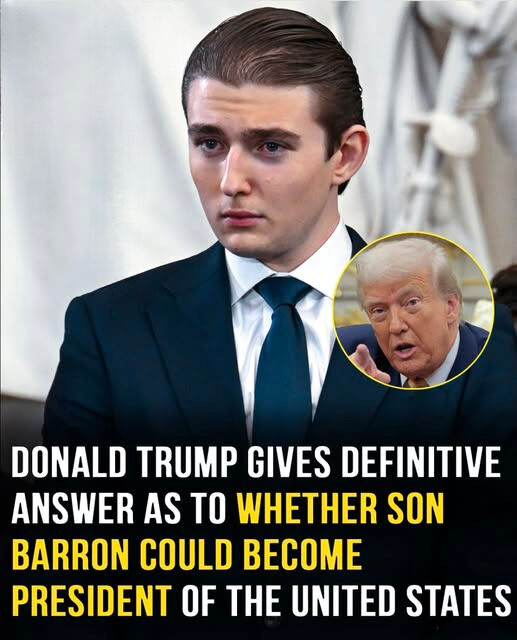
American politics often feels like a high-stakes drama, full of sudden twists, larger-than-life personalities, and a future that defies even the most careful predictions. In this context, Donald Trump reestablished himself as a dominant force during the 2024 presidential election. His victory wasn’t just a win—it was a seismic event that reshaped the Democratic Party’s strategy and sent shockwaves through international politics. As he begins his second term, the discussion has shifted from how he won to what comes next—specifically, whether his political movement could evolve into a family legacy.
Questions about a potential Trump succession have circulated for years. While the 22nd Amendment limits Donald Trump’s own time in office to January 2029, the political momentum he created shows no signs of slowing. Many observers see his children as the most natural heirs to his influence. Previously, attention focused on Donald Jr. and Ivanka, who both played central roles in his first administration. Yet neither has publicly committed to a presidential bid, leaving speculation increasingly centered on Barron Trump, the youngest sibling.
Having grown up in the shadow of the White House and campaign trail, Barron occupies a unique position. At 19, he bridges the traditional Trump brand and a younger, digitally savvy generation. In a recent interview with Laura Ingraham of Fox News, Donald Trump was asked whether any of his children might be suited for the Oval Office. While he praised all his children’s intelligence, patriotism, and achievements, he highlighted Barron, calling him “meticulous” and predicting he would excel in high-pressure situations. Though the president stopped short of declaring Barron a future candidate, his comments suggested strong confidence in his youngest son’s potential.
Legally, Barron is years away from eligibility; the U.S. Constitution requires a president to be at least 35. Currently, he is focused on his studies at NYU’s Stern School of Business. Unlike his older siblings, he has remained largely private, rarely revealing political ambitions or personal plans.
Despite this, both Donald and Melania Trump have shared glimpses of Barron’s involvement in the 2024 campaign. According to the First Lady, he was far from a passive presence. She described him as a “grown young man” with a sophisticated grasp of modern political strategy. Barron played a key role in advising his father on engaging younger voters through digital platforms, identifying influencers, podcasters, and content creators to connect with a generation that has largely moved away from traditional media.
“He understands his generation,” Melania said. His insights into digital media helped the campaign reach voters that conventional strategies often overlook, demonstrating his potential as a strategist even if he never seeks office himself.
The idea of a Trump dynasty sparks intense debate. Supporters see it as the continuation of a movement focused on national sovereignty and populism; critics worry it risks concentrating power within a single family. Barron’s role highlights the broader question of how the Trump legacy will evolve. Will he carry forward his father’s meticulous style into a new political brand, or pursue a private life outside the spotlight?
For now, Barron remains in a period of political dormancy while completing his degree. The next decade will likely involve balancing the privacy of a typical college experience with the intense scrutiny that comes with his family name. If he chooses to enter politics in the future, he will do so with global recognition and a built-in base of supporters. Until then, the notion of Barron as the “next Trump president” remains speculative, a symbol of curiosity about the future of the movement his father built.
Leave a Reply