Cleverer Than It Appears
Uncategorized
March 31, 2026adminLeave a Commenton Cleverer Than It Appears
A Surprising Discovery
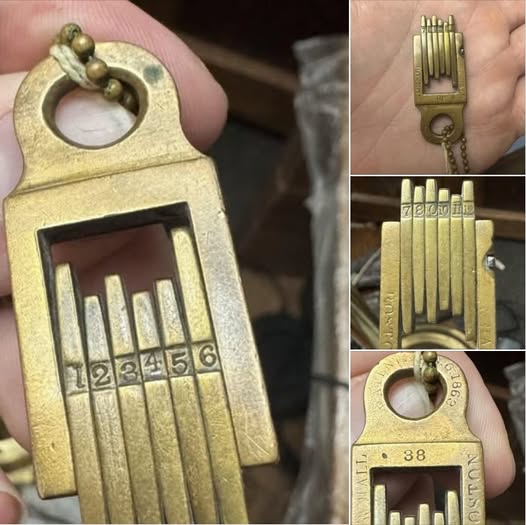
At first glance, I assumed this object was some type of gauge, possibly a steam gauge from the 1800s. Its weight, 12 numbered tabs, and small side pin suggested a measuring device. But when I noticed the words “PATENT 1863”, everything changed.
It wasn’t a gauge at all. It was an 1863 W. Hall brass combination lock, patented in Boston in the middle of the Civil War. Once I realized this, the lock’s design made perfect sense—and became far more fascinating.
What This Lock Is
The combination lock was patented by W. Hall on January 6, 1863 as U.S. Patent #37,290. Crafted from solid brass, it’s a compact lock designed to secure small items like lockboxes, trunks, or travel cases. The loop on top indicates it was meant to attach to an item rather than being built into it.
Unlike modern combination locks, this device doesn’t use a key or rotating dial. Instead, it relies on 12 flat brass tabs, each numbered and able to slide or pivot slightly. Inside, each tab has a notch. When all tabs are aligned correctly, the notches line up, allowing the internal bolt to move.
Even a single misaligned tab keeps the lock secure and closed.
How the Mechanism Works
The lock operates entirely on precision alignment. There are no springs or gears. The combination exists solely in the positioning of the tabs. A side pin applies tension until the tabs line up properly.
This is what makes the 1863 W. Hall brass combination lock so impressive. The lock relies purely on precision machining, and brass, while durable, doesn’t wear well. That explains why many of these locks still operate smoothly today.
I spent considerable time sliding the tabs back and forth. You can feel the alignment, a tactile sense of when you’re getting close—and when you’re not.
Patent Markings and Details
The lock bears clear markings: “W. HALL” and “BOSTON”, matching the patent records. The “38” near the top may indicate a model or production number, though no records confirm this.
The patent describes a compact, portable lock for personal safety, and the lock’s construction matches this description perfectly. It’s entirely functional—no decorative elements, nothing superfluous.
Why It’s Often Misidentified
At first glance, the lock resembles a wire gauge or measuring device. Its 12 numbered tabs look like thickness gauges. Without understanding the mechanism, most people miss its true purpose, leading to frequent mislabeling.
Once you know how it works, the design becomes obvious and elegant. Until then, it appears like a mechanical puzzle.
Collector Interest
These locks represent an early step in combination-based security. No key existed, so the combination lived only in the user’s mind.
Collectors prize the 1863 W. Hall brass combination lock for its historical significance, mechanical ingenuity, and durability. Over time, the brass develops a rich patina, yet the lock continues to function—an unusual quality for antique items.
It also serves as a reminder that products from the 1860s were built to last. This lock wasn’t designed for replacement—it was designed to perform reliably.
Final Thoughts
At first glance, the lock may seem unremarkable. But once you understand its purpose, it commands respect. Small, precise, and still fully functional more than 150 years later, the 1863 W. Hall brass combination lock is a testament to expert design and craftsmanship.
It doesn’t need to impress visually. It works exactly as intended—and it still works flawlessly. That’s proof that W. Hall got it right the first time.
Leave a Reply