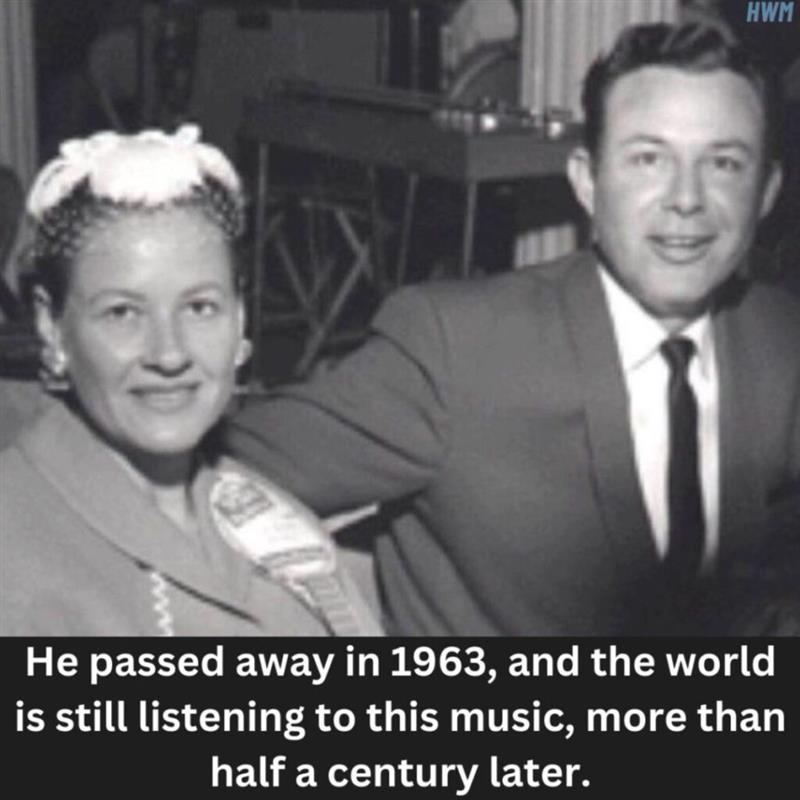
In 1960, Jim Reeves released a song that would quietly but permanently change the direction of both country and popular music.
The song was titled “He’ll Have to Go,” and while it arrived without shock tactics or flashy production, its emotional power, elegance, and restraint resonated deeply with listeners.
Over time, it became more than just a hit record—it became a defining moment in American music history.
At a time when country music was still widely perceived as regional and traditional, “He’ll Have to Go” crossed boundaries.
It appealed not only to country audiences but also to pop listeners who had never before connected with the genre.
The song’s success proved that country music could be sophisticated, emotionally subtle, and universally relatable without losing its identity.
Jim Reeves’ voice was central to that achievement. Smooth, warm, and controlled, his baritone stood apart from the rougher vocal styles that dominated country music in earlier decades.
He sang with restraint rather than force, letting emotion flow naturally instead of pushing it forward. This approach gave “He’ll Have to Go” a timeless quality that still holds its power more than six decades later.
The Man Behind the Voice
Jim Reeves, often called “Gentleman Jim,” was not an accidental star. Born James Travis Reeves on August 20, 1923, in Galloway, Texas, he grew up surrounded by music but also by discipline and responsibility.
Before committing fully to a music career, Reeves worked as a radio announcer and disc jockey, a role that helped shape his smooth delivery and refined speaking voice.
His time behind the microphone taught him pacing, tone, and clarity—skills that later became trademarks of his singing style.
Unlike many performers who relied on volume or dramatic inflection, Reeves understood the power of understatement. He knew when to pull back, when to pause, and how to let silence carry meaning.
By the late 1950s, Jim Reeves was already a respected figure in country music. He had charted several successful songs and built a loyal fan base.
Still, he had not yet achieved the kind of crossover success that would make him a household name beyond the genre. That changed completely with the release of “He’ll Have to Go.”
The Unlikely Inspiration Behind the Song
The origins of “He’ll Have to Go” are as memorable as the song itself. It was written by husband-and-wife songwriting duo Joe and Audrey Allison, both accomplished figures in country music.
The idea came from a real-life moment Joe Allison witnessed in a bar.
He overheard one side of a telephone conversation in which a man was speaking urgently to someone on the other end of the line.
The man repeatedly asked the woman to move closer to the phone so he could hear her better. His tone suggested desperation, longing, and emotional vulnerability. That simple, intimate moment became the foundation for the song.
The opening line—“Put your sweet lips a little closer to the phone”—immediately draws the listener into a private emotional space.
There is no dramatic introduction or elaborate storytelling. Instead, the listener becomes a witness to a deeply personal plea, one that feels honest and unguarded.
This simplicity was the song’s strength. It did not rely on complicated metaphors or grand declarations.
It focused on a single emotional moment—the realization that love is slipping away and that one final attempt might be the last chance to hold on.
Recording a Classic
When Jim Reeves recorded “He’ll Have to Go,” he approached it with care and restraint. The production was handled by Chet Atkins, one of the most influential producers in country music history.
Atkins was a key architect of what later became known as the Nashville Sound, a style designed to make country music more accessible to mainstream audiences.
Instead of fiddles and honky-tonk rhythms, the arrangement featured gentle instrumentation and subtle orchestration.
The goal was not to overwhelm the listener but to frame Reeves’ voice in a way that enhanced its emotional clarity. Every musical choice served the song rather than distracting from it.
Reeves delivered the vocal in a low, intimate register, almost as if he were speaking directly to one person rather than singing to a crowd.
There was no unnecessary embellishment. Each word was clearly articulated, and each pause carried emotional weight. The result was a performance that felt deeply personal, even when played over the radio.
Breaking Barriers and Reaching New Audiences
Upon its release, “He’ll Have to Go” quickly climbed the charts. It reached number one on the Billboard Country Chart and crossed over to the pop charts, where it peaked at number two.
This crossover success was still relatively rare at the time and marked a turning point in how country music was perceived.
The song demonstrated that country music could succeed on a national and even international level without sacrificing emotional honesty.
It appealed to listeners who may not have identified as country fans but recognized the universal themes of love, vulnerability, and heartbreak.
Radio stations across formats embraced the song, and it became a staple on jukeboxes throughout the United States.
Its popularity was not driven by hype or controversy but by word of mouth and repeated listening. People returned to the song because it made them feel something genuine.
A Defining Moment for the Nashville Sound
“He’ll Have to Go” played a major role in establishing the Nashville Sound as a dominant force in country music.
This smoother, more polished approach helped bridge the gap between traditional country and mainstream pop. It allowed artists to reach broader audiences while maintaining emotional depth.
Jim Reeves became one of the most important figures associated with this movement.
His image, voice, and musical choices represented a new kind of country artist—one who could perform on international stages, appeal to diverse audiences, and still remain true to the genre’s emotional core.
The success of the song elevated Reeves from a popular country singer to an international star. He toured extensively, performing in Europe, South Africa, and beyond, bringing country music to listeners who had never encountered it before.
In many places, he became one of the first country artists audiences truly embraced.
Long after “He’ll Have to Go” left the charts, its influence continued to grow. Unlike many hit songs that fade with time, this recording became stronger with each passing decade.
Its emotional honesty, simplicity, and timeless arrangement allowed it to remain relevant across generations. The song did not belong to a specific era—it belonged to human experience.
Listeners continued to discover the song through radio, jukeboxes, and later through film, television, and digital media.
Its quiet intensity stood in contrast to louder musical trends, offering something rare: intimacy. The song felt less like a performance and more like a private confession, which helped it maintain its emotional impact long after its initial release.
Music historians often point to “He’ll Have to Go” as a defining example of how restraint can be more powerful than excess.
There were no dramatic crescendos or complex lyrics—just a simple story delivered with sincerity. That approach influenced generations of artists who learned that sometimes the most effective music is the most honest.
Covers, Tributes, and Cultural Reach
The song’s influence is also reflected in the number of artists who chose to record their own versions.
Legendary performers such as Elvis Presley, Ry Cooder, Charlie Rich, and others offered interpretations that reflected their own styles. Yet, even among these respected artists, Jim Reeves’ original recording remained the definitive version.
Elvis Presley’s cover, while powerful, leaned more toward his dramatic vocal style. Ry Cooder approached it with a blues-inflected sensibility.
Each version highlighted different emotional aspects of the song, but none replaced the quiet authority of Reeves’ performance.
This enduring respect speaks volumes about the original recording. It was not just technically excellent—it captured a specific emotional truth that proved difficult to replicate.
Reeves’ voice, delivery, and timing created a balance that felt complete, leaving little room for improvement.
Beyond recorded covers, “He’ll Have to Go” became a frequent presence in popular culture. It appeared in films, television shows, and documentaries, often used to underscore moments of reflection, heartbreak, or emotional transition.
Each appearance introduced the song to new audiences, reinforcing its place in the cultural memory.
Jim Reeves as a Global Ambassador for Country Music
Following the success of “He’ll Have to Go,” Jim Reeves’ career expanded rapidly beyond the United States. He became one of the first country artists to achieve significant international popularity.
His polished image, smooth voice, and emotional accessibility made him appealing to audiences unfamiliar with traditional country music.
Reeves toured extensively across Europe, Africa, and other regions, performing to sold-out venues and appearing on international television programs.
In countries such as South Africa and the United Kingdom, he became a household name, helping establish country music as a global genre.
What set Reeves apart was his ability to adapt without compromising authenticity. He did not alter his musical identity to fit foreign audiences.
Instead, he trusted that emotional truth would translate across cultures—and it did. Love, longing, and vulnerability required no translation.
A Tragic and Untimely Loss
Despite his growing success, Jim Reeves’ life was tragically cut short. On July 31, 1964, at just 40 years old, Reeves died in a plane crash near Brentwood, Tennessee. He was piloting the aircraft himself when it encountered severe weather conditions.
The news of his death sent shockwaves through the music world. Fans, fellow musicians, and industry professionals mourned the loss of an artist who still had so much to give.
His passing created a void not only in country music but in popular music as a whole.
At the time of his death, Reeves was at the height of his artistic maturity. He had already reshaped the genre and was continuing to evolve creatively.
Many believe that had he lived longer, his influence would have expanded even further, possibly reshaping country music yet again.
Posthumous Recognition and Lasting Respect
In the years following his death, Jim Reeves’ legacy continued to grow. His recordings remained popular, and his influence became more widely acknowledged.
He was posthumously inducted into the Country Music Hall of Fame, an honor that recognized both his artistic achievements and his role in expanding the reach of country music.
Reeves also received numerous lifetime achievement recognitions, reflecting the lasting value of his work. His recordings continued to sell, and his songs remained staples on country and adult contemporary radio stations.
Importantly, his legacy was not preserved through nostalgia alone. Younger generations of artists and fans continued to find meaning in his music.
For many listeners, “He’ll Have to Go” became an entry point into classic country music, opening the door to a deeper appreciation of the genre’s history.
Influence on Modern Country and Pop Artists
The impact of Jim Reeves and “He’ll Have to Go” can be heard in the work of many modern artists. Performers such as Shania Twain, Taylor Swift, Keith Urban, and others benefited from the path Reeves helped create—a space where country music could cross into mainstream pop without losing emotional depth.
The Nashville Sound, which Reeves helped popularize, became a foundation for contemporary country-pop fusion. Smooth production, emotional clarity, and crossover appeal are now standard elements in the genre, thanks in part to pioneers like Reeves.
His influence also extends beyond genre boundaries. Artists in jazz, folk, and even soul music have cited Reeves’ vocal control and emotional delivery as inspirations.
His work demonstrated that technical excellence and emotional honesty are not opposing forces but complementary ones.
Why “He’ll Have to Go” Still Matters
More than sixty years after its release, “He’ll Have to Go” remains one of the most beloved songs in country music history. Its continued relevance lies in its universality.
The song speaks to moments of emotional uncertainty that nearly everyone experiences at some point in life.
Its power comes from what it does not say as much as what it does. The pauses, the softness, and the restraint allow listeners to project their own emotions into the song. This open emotional space is what gives it lasting meaning.
In an era of fast-changing trends and constant noise, “He’ll Have to Go” stands as a reminder that quiet sincerity can be timeless. It proves that music does not need to shout to be heard—it only needs to be honest.
A Legacy That Continues to Roll On
Jim Reeves proved that country music could be elegant, emotional, and universal. Through “He’ll Have to Go,” he helped redefine the genre and expand its reach, leaving a lasting imprint on music history.
Though his life ended too soon, his voice continues to resonate. Each time the song is played, it carries forward the values he embodied: grace, simplicity, and emotional truth.
His work remains a testament to the enduring power of music to connect people across time, culture, and generations.
“He’ll Have to Go” was not just a successful song—it was a moment that changed music forever. And as long as listeners continue to seek sincerity and meaning in music, Jim Reeves’ legacy will continue to live on.
Leave a Reply