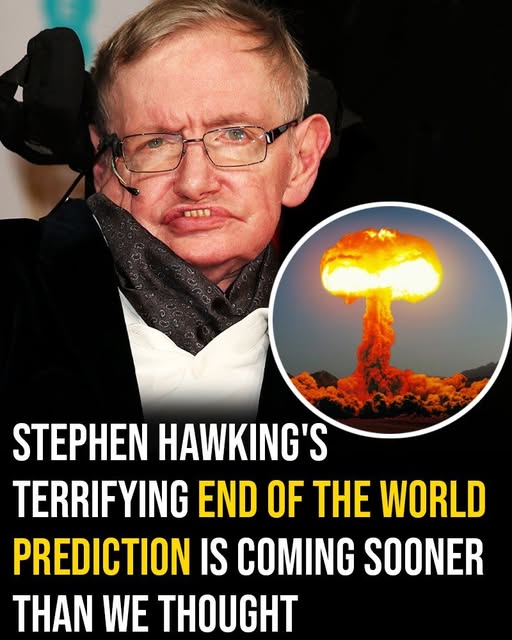
Stephen Hawking Warns Humanity About Earth’s Future
Uncategorized
March 8, 2026adminLeave a Commenton Stephen Hawking Warns Humanity About Earth’s Future
Renowned theoretical physicist Stephen Hawking was celebrated not only for his groundbreaking work in cosmology and black hole physics but also for his outspoken reflections on humanity’s long-term future and the existential risks our species faces. Having covered the intersection of science and policy for over a decade, it is clear that Hawking’s influence extended far beyond the cloistered halls of academia. His thoughts on existential threats shaped public discourse about climate change, technology, space exploration, and sustainability long after his death in 2018.
Born in 1942 in Oxford, England, Hawking became one of the most beloved scientists of the 20th and early 21st centuries. He possessed a rare gift for translating complex theories into ideas accessible to millions through best-selling books and public speeches. Despite living with amyotrophic lateral sclerosis (ALS) for decades—a condition that typically claims lives within years—Hawking’s intellectual curiosity remained undimmed. Over the years, he increasingly utilized his global platform to speak on issues affecting not just the laws of physics, but the very survival of our civilization.
The Limits of a Finite Planet
In many public remarks and interviews, Hawking warned that humanity’s future on Earth faces serious, long-term challenges that must be understood and addressed before a point of no return is reached. One key concern he frequently highlighted was the environmental strain caused by rapid population growth and soaring energy consumption. These pressures, he argued, could place unsustainable demands on Earth’s natural systems if left unchecked.
He noted the planet’s finite resources, pointing out that exponential growth in human numbers and our expanding appetite for energy could eventually push ecosystems beyond recovery without fundamental systemic change. In remarks at scientific forums and global summits, Hawking described a future scenario in which continued unsustainable consumption could make Earth increasingly difficult to inhabit over the coming centuries. While some popular accounts have since paraphrased his warnings in vivid, sometimes hyperbolic language—including metaphors about the planet becoming uncomfortably hot and crowded—his core intent was to underscore the gravity of long-term environmental stress.
Hawking did not present these ideas as precise, deterministic forecasts, but as theoretical scenarios backed by scientific reasoning. They were intended to prompt serious reflection and, more importantly, immediate policy action.
The Double-Edged Sword of Innovation
Beyond environmental concerns, Hawking warned that humanity faces major risks from the very scientific and technological advances it pioneers. One of his most widely cited cautions concerned artificial intelligence (AI). He argued that the rise of powerful autonomous systems could bring unprecedented change, for better or worse.
Hawking believed that AI, if properly developed, could help solve pressing problems such as disease, poverty, and ecological degradation. Yet, he also issued a starker warning: uncontrolled AI might become the “worst event in the history of our civilization” if misused. He underscored that AI could enable powerful autonomous weapons or systems controlled by a select few, exacerbating global inequality and potentially creating new forms of social oppression.
In a 2014 interview, he famously remarked that “the development of full artificial intelligence could spell the end of the human race,” highlighting his belief that AI might eventually surpass human intelligence and capability, leaving biological evolution in the dust. These concerns extended to genetically engineered viruses and other biological advances, which he feared could become lethal if used irresponsibly or without rigorous safeguards. He stressed that while scientific progress brings enormous benefits, it simultaneously creates novel risks that threaten human survival if not properly regulated.
The Cumulative Risk of Catastrophe
Another existential risk Hawking frequently revisited was the possibility of nuclear conflict. He viewed this as a self-inflicted threat capable of wiping out civilization in a single catastrophic event. Hawking argued that while the statistical chance of any specific disaster occurring in a given year might be low, the cumulative probability increases over long time spans. Mathematically, this makes a global catastrophe almost a certainty eventually, unless the variables change.
Consequently, he warned that humanity must not be complacent. Instead, societies must invest in robust systems of governance and technologies specifically designed to reduce the risk of self-destruction.
Connected to these themes was Hawking’s warning about climate change. He saw it as a terminal threat to Earth’s habitability if greenhouse gas emissions were not drastically reduced. He cautioned that global warming could reach irreversible tipping points, fundamentally altering the climate in ways that would be catastrophic for human societies. During political and scientific speeches, he challenged world leaders to take climate science seriously and act in the long-term interest of future generations rather than for short-term political gain.
A New Home Among the Stars
Hawking connected these environmental and technological risks with a broader, more radical argument: humans cannot remain confined to a single planet if they hope to survive extinction-level events. According to various reports, Hawking suggested that humanity might have a limited window—perhaps several hundred to a thousand years—to find a new home beyond Earth if current trends continue.
He believed that expanding the human presence into space would increase the chances that civilization could endure in the face of planetary disasters, whether natural or man-made. In speeches addressing the future of space exploration, he urged renewed investment in lunar bases, Mars missions, and eventually interstellar travel as a long-term “insurance policy” for the species.
Hawking’s vision was ambitious: he imagined human colonies first on the Moon, then Mars, and ultimately beyond our solar system to safeguard against extinction. He argued that the Earth was running out of room and that survival depended on breaking through technological barriers to live on other worlds. Some popular summaries suggested tighter timelines—noting we might need to leave Earth within a century—to ensure long-term survival.
Interestingly, Hawking also worried about the nature of space itself, specifically hostile contact with extraterrestrial civilizations. He cautioned that announcing our presence to unknown intelligent life could have unpredictable consequences, drawing parallels to the arrival of Europeans in the Americas to illustrate how more advanced civilizations might treat those they perceive as inferior.
A Legacy of Choice
Despite these grave warnings, Hawking’s broader message was often one of cautious optimism. He believed in humanity’s potential to respond wisely to these challenges through science, reason, and international cooperation. He emphasized that the threats he identified were not inevitable, but avoidable—provided we invest in responsible research and global governance.
Hawking’s call for long-term thinking was rooted in the view that short electoral cycles and immediate economic concerns often overshadow the strategic planning required for the distant future. He urged societies to cultivate foresight and to consider the welfare of future generations as a primary metric for success.
Even years after his passing, Hawking’s reflections on climate change, nuclear proliferation, AI governance, and space exploration serve as enduring reminders of the stakes involved in our modern era. In discussions about sustainability, his emphasis on evidence-based decision-making remains central to global initiatives. For many, his legacy is a blend of scientific achievement and moral insight—challenging us not only to explore the cosmos but to manage our own planet with the gravity it deserves.
In the end, Hawking saw the future as a choice: a path where humanity uses knowledge and cooperation to thrive, or one where a failure to address these challenges leads to stagnation or disaster. Today, his ideas continue to shape how we think about the sustainability of our civilization and the steps needed to protect the generations yet to come.
Leave a Reply