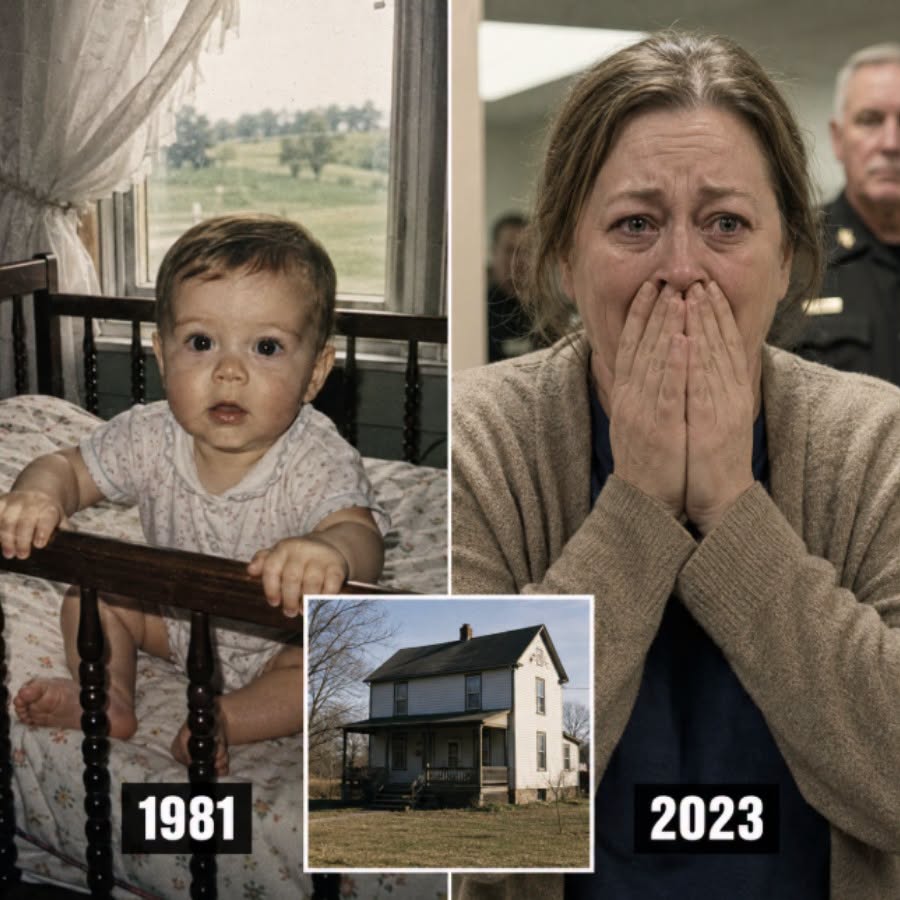
In the spring of 1981, a 6-month-old baby disappeared from a rented farmhouse outside Altuna, Pennsylvania. There was no broken window, no overturned furniture, no witness who could remember seeing anyone enter the property. And when investigators arrived that afternoon, the baby’s crib was still beside the bedroom window with a folded blanket resting across the mattress.
The parents insisted they had left the baby there for less than 20 minutes. That detail would remain at the center of the case for decades. For years, investigators believed the child had been taken by someone who knew the family. The problem was that nobody could explain how that person had gotten into the house without being seen.
Then, 42 years later, a county records clerk reviewing an unrelated property file noticed a name that had appeared nowhere in the original investigation. The name belonged to a woman living more than 600 m away. And according to the record, she had been paying taxes on a small house for almost three decades.
There was nothing unusual about the property itself. The unusual part was the date the woman had purchased it. It was only 3 months after the baby disappeared. On June 14th, 1981, 19-year-old Naen Voss woke shortly after 6:00 in the morning and found her infant daughter asleep in the crib beside her. Naen had been living with her husband, Orin, in a two-story farmhouse on a narrow road outside Altuna.
Orin repaired agricultural equipment for a machinery dealer. Naen worked part-time at a bakery in town and spent most of her days caring for the baby. Their daughter Karen had been born in November. She was small for her age, but healthy, and Naen had developed the habit of checking on her several times during the night.
That morning, the family had plans to visit Orin’s older brother for lunch. Naen remembered putting laundry into the washing machine around 8. Orin left shortly afterward to pick up a replacement belt for a customer’s tractor. At approximately 9:20, Naen walked outside carrying a basket of clothes.
She hung several shirts on a line behind the house. Then she went back inside. The entire trip took less than 20 minutes. When she returned to the bedroom, the crib was empty. At first, Naen thought Orin had come home early. She checked the kitchen, then the bathroom, then the small porch at the back of the house. She called his name twice before noticing that the front door was still locked.
Orin arrived about 12 minutes later. By then, Naen had already called the sheriff’s office. The first deputy reached the farmhouse at 9:51. His name was Harold Wikert. He was 52 years old and had worked patrol in Blair County for nearly two decades. Wikert later wrote that the house appeared unusually orderly.
There was no obvious sign of forced entry. The windows were closed, the doors were locked, the baby’s diaper bag was still hanging from a hook beside the kitchen. Even the stroller remained in the hallway. What bothered Wert was the bedroom window. It was open approximately 4 in. Naen told him she had not opened it that morning.
Orin said he couldn’t remember whether it had been open when he left. The deputy looked outside. The ground beneath the window was soft from rain the previous evening, but he found no clear footprints. There was one shallow impression near the foundation. It looked as though something heavy had been placed there.
Wikert photographed it. Nobody ever determined what had made it. By noon, the road outside the farmhouse was crowded with patrol cars. Neighbors came to the property. Family members arrived. Search teams checked the surrounding fields, drainage ditches, barns, and wooded areas. A state police unit brought tracking dogs. The dogs followed a scent from the baby’s blanket toward the rear of the property.
Then the trail stopped near an old gravel road. That seemed important until investigators learned the same road was used every morning by a milk delivery truck. The trail could have been disturbed dozens of times. By evening, the search had expanded beyond the farm. Road blocks were established on nearby highways. Hospitals were contacted. Bus stations were checked.
Photographs of Karin were distributed to surrounding counties. But there was another problem. The photograph investigators had was almost 6 weeks old. Naen had taken it at Easter. Currin’s face had changed slightly since then. Her hair was longer, her cheeks were fuller, and there was no photograph showing the exact clothing she had been wearing that morning.
The family could remember the baby’s pajamas. They could not agree on the color. That small disagreement became one of the first cracks in the timeline. Orin said they were pale yellow. Naen insisted they were white. A neighbor remembered seeing a blue blanket. Naen said the blanket was pink. None of these details seemed important at the time, but 42 years later, one of them would become impossible to explain.
The investigation continued through the summer. Detectives interviewed nearly everyone who lived within several miles of the farmhouse. One man drew particular attention. His name was Leander Puit. He operated a small appliance repair shop about 4 miles away and had occasionally visited Orin’s workplace. Puit owned a dark green station wagon.
A neighbor claimed she had seen the vehicle parked near the farmhouse 2 days before the disappearance. Puit denied being there. Investigators checked his work records. He had been repairing a refrigerator at a residence across town that morning. The homeowner confirmed it. Puit was cleared, but his station wagon remained in the file because another witness later described seeing a similar vehicle near the gravel road.
That witness was never certain of the make. The case began accumulating possibilities without producing answers. By September, investigators had interviewed more than 100 people. No one had seen Karin after Naen left the house. No ransom demand arrived. No suspicious bank withdrawal appeared. No one claimed to have received a strange phone call.
The family had no known enemies. There was no custody dispute. There was no obvious financial motive. And there was no reason anyone could identify for taking an infant from a locked house in broad daylight. Then a new detail appeared. A woman named Bess Harkkins contacted police.
She lived on the opposite side of the valley and rarely spoke with the Voss family. Harkkins said that 3 days before the disappearance, she had seen Naen speaking with an unfamiliar woman outside the bakery where Naen worked. The woman was carrying a cardboard box. According to Harkkins, the conversation had looked tense.
Naen later denied remembering it. That should have ended the lead. Instead, investigators discovered that the bakery’s manager remembered the woman. She had come inside asking whether Naen still worked there. She had not bought anything. She had simply stood near the counter and watched Naen for several minutes before leaving.
The manager couldn’t remember her name, but she remembered something else. The woman had been wearing a hospital identification bracelet. That detail changed the direction of the investigation. Detectives began contacting hospitals across central Pennsylvania. They discovered several women had recently given birth. One had left a hospital without completing her discharge paperwork.
Another had used a false surname. A third had moved out of state. For several weeks, investigators followed those leads. None connected to Karen. Then in October, the investigation took another unexpected turn. The hospital bracelet belonged to a woman named Mora Cisk. Cisk had delivered a stillborn child two weeks before Karen disappeared.
She had been discharged under her own name. There was no evidence connecting her to the Voss family. She lived nearly 60 mi away. But when investigators interviewed her, she made an odd statement. She said she had never heard of the Voss family. Then before the detective could ask another question, she asked whether the baby had been found.
That question was entered into the report. Cisk later explained that she had heard about the disappearance from a radio broadcast. The detective accepted the explanation. At the time, there was no reason not to. The case gradually went quiet. By 1983, the searches had stopped. By 1985, the original detective had retired. By the end of the decade, Currin’s photograph had disappeared from most local bulletin boards. Naen continued searching.
She kept a box of newspaper clippings beneath her bed. Every few months, she contacted a missing child organization. Every Christmas, she bought a small gift she knew she would never have a chance to give. Orin handled the disappearance differently. He stopped talking about it. Their marriage eventually ended.
He moved to Ohio in 1988. Naen stayed in Pennsylvania. Neither of them ever publicly accused the other of knowing more than they admitted. But privately, both believed the other had withheld something. That belief would become important decades later. Because in 1994, Orin made a statement that never appeared in the original case file.
He told a friend that Naen had received a letter shortly after Karen disappeared. The friend remembered only one detail. The envelope had no return address. Naen denied ever receiving it. There was no way to verify the story. The friend died in 2007. The letter was never found. For years, it seemed like another dead end.
Then came 2003. A woman named Darlene Fe purchased a modest house outside Fort Wayne, Indiana. She was 32 years old. She worked as a bookkeeper for a regional plumbing company. She lived quietly. She had no criminal record, no unusual employment history, no connection to Pennsylvania that anyone knew about.
Her birth certificate listed her name as Darlene Fe. Her adoptive parents had always told her she had been born in western Pennsylvania. They said her biological mother had been young and unable to care for her. Darlene accepted that explanation. There was one part of her childhood she never understood. Her adoptive mother refused to discuss the day Darlene had arrived.
Whenever Darlene asked where the adoption papers were, her mother said they had been lost during a move. Darlene eventually stopped asking. Her adoptive father died in 2014. Her mother died 3 years later. While cleaning the house after the funeral, Darlene found a small envelope taped beneath a drawer. Inside was a handwritten list of dates.
There were only six. The first was November 22nd, 1980. The last was September 3rd, 1981. None had an explanation. Darlene assumed they were medical appointments. She put the paper aside. Then in 2022, she ordered a commercial genealogy test. She wasn’t searching for a missing child. She wanted to know where her biological family came from.
The results were surprising. Her closest genetic match was a woman in Pennsylvania. The relationship estimate suggested they were close relatives. Darlene contacted her. The woman never responded. Instead, Darlene received a message from the woman’s adult daughter. The daughter asked one question. Do you know anything about a baby named Karin? Darlene had never heard the name. She searched it.
The first result was an old newspaper archive. The photograph showed a smiling infant wrapped in a blanket. Underneath it was a short article from 1981. Darlene stared at the photograph for several minutes. She couldn’t explain why. There was something familiar about the child’s face. Not enough to prove anything, just enough to make her uncomfortable.
She contacted the Pennsylvania woman again. This time the response came within an hour. The woman asked Darlene not to contact her family anymore. Then she deleted her account. Darlene saved the message. She also saved the newspaper article and for the first time she began wondering whether the story she had been told about her birth was incomplete.
She requested her original birth records. The county office sent back a document that appeared ordinary. Darlene’s birth date was listed as November 19th, 1981. Her place of birth was a hospital in Indiana. Her mother’s name was recorded as Morris Cisk. Darlene stopped reading. She knew that name. She had seen it before, not in her family.
In the newspaper archive, Morris was the woman who had been questioned in connection with Karen Vas’s disappearance. Darlene printed the birth certificate. Then she placed it beside the newspaper clipping. The dates were only 3 months apart. There was no proof yet, but one question was suddenly unavoidable.
Why had the woman connected to the missing baby’s investigation become listed as Darlene’s biological mother? Darlene contacted an attorney. The attorney advised her not to confront anyone until the records had been verified. A second document was requested. This time it was an adoption file.
The file had been sealed for decades. But a recent change in Indiana law allowed Darlene to request certain non-identifying information. The response arrived 6 weeks later. Most of the pages were heavily redacted. One page was different. It contained a handwritten notation from 1981. The ink had faded. The handwriting was difficult to read, but the final line was clear.
Child transferred from Pennsylvania. There was no county listed, no hospital, no mother’s signature, no explanation, only four words. Darlene took the document to a retired record specialist. He examined it for nearly an hour. Then he pointed to the bottom corner. There was a number. It wasn’t an adoption number. It was a property reference.
The same type of reference used in Pennsylvania county records. Darlene had no idea what it meant. Neither did her attorney, but the record specialist did. He told her the number appeared to identify a parcel of land. And when they searched the old county index, the property had an unexpected connection to the Voss family.
It had belonged to Naen’s father. The property had been sold only weeks after Karen disappeared. The buyer was a woman named Mora Cisk. For 42 years, nobody had connected those two records. And suddenly, the case was no longer just about a missing child. It was about why a woman who had been questioned in 1981 had quietly acquired property from the missing baby’s family.
There was still one problem. Darlene was not Karen. At least, nobody could say that yet. The birth dates were different. The records had contradictions, and genetic genealogy could suggest a relationship without explaining what had happened. Investigators would need more than a coincidence.
They needed something that connected the child in the 1981 photograph to the woman living in Indiana. That evidence came from an unexpected place, not a police file, not a DNA database, not an old photograph. It came from a church basement in western Pennsylvania. In 2023, a volunteer archavist named Rosalie Mter was cataloging boxes of membership records from a church that had closed years earlier.
Most of the documents were routine donation lists, funeral programs, wedding announcements, Sunday school rosters. Then she found a small ledger from 1981. One entry had been crossed out. The original name beneath the correction was still visible. Rosalie recognized it immediately. Kinvos. Next to the name was a date, June 15th, 1981.
One day after the disappearance, and beneath it was another name, Morris. Rosalie initially assumed it was an administrative mistake. Then she noticed the handwriting. The entry had not been made by the church secretary. It had been written by someone else. Someone who had apparently added the baby’s name to a membership record after Karen had already disappeared.
And beside the child’s name was a note that made the entire timeline more difficult to understand. The note contained only three words. Bring her Sunday. Nobody knew who had written it. But suddenly there was a record suggesting that someone expected Karen to appear at the church the morning after she vanished. And that meant the disappearance may have been planned long before Naen stepped outside that June morning.
Rosalie did not photograph the ledger immediately. Instead, she carried it into the church office and placed it beneath a desk lamp. The ink was faded, but the words were unmistakable. Bring her Sunday. The date beside them was June 15th. Rosalie checked the church calendar from that year. June 15th, 1981 was a Monday.
There had been no Sunday service on that date. That made the notation stranger. She checked the following Sunday, June 21st. Then she noticed another entry written in the margin. Private room. There was no explanation. Rosalie contacted the county historical society before telling anyone connected to the Voss family. The archavist there asked her to scan the entire page. Rosalie did.
Then she scanned the pages immediately before and after it. The surrounding entries were ordinary. A baptism, two wedding announcements, a donation from a local hardware store. Nothing else appeared connected to the child. But when the scans were enlarged, something appeared in the upper corner of the page. a set of initials.
Rosalie recognized the handwriting. It belonged to Reverend Amos Keter. He had been the church’s pastor in 1981. He had also died in 1996. That should have ended the trail. Instead, the historical society had one more box. Keter’s personal administrative records had never been fully cataloged. The box contained correspondence, handwritten notes, and several appointment books.
Rosalie opened the 1981 appointment book. Most pages were filled with names and times. On June 13th, there was an entry at 4:30 p.m. Mora, no last name. On June 14th, the day Karin disappeared, the appointment book contained nothing. On June 15th, there was another entry. Mother and child, no name, no time.
Rosalie stopped turning the pages. She photographed the entry and sent it to the county investigator who had recently reopened the records review. His first question was simple. Why would a pastor be meeting with him? Nobody had an answer. The investigator began searching Keter’s records for other references to Morris. There were three.
One was from 1980. One was from June 1981. The third was dated September 1981. The September note contained only a phone number. The number belonged to a business in Fort Wayne, Indiana. That business no longer existed, but its old telephone directory listing did. It had been a small accounting office, and the name of the office manager was Darlene Fe’s adoptive mother.
The connection was still circumstantial, but it was no longer easy to dismiss. Investigators requested permission to examine the original adoption records in Indiana. The request took weeks. When the file finally arrived, one page was missing. Not redacted. Missing. The file was numbered consecutively, and the sequence jumped from page 12 to page 14.
Page 13 had been removed before the records were transferred to the county archive. Nobody could explain who had removed it. Then a retired clerk remembered something. She said older adoption files had sometimes been copied before being sealed. If a copy existed, it might be stored in a state archive. The investigators searched.
A duplicate was found. The missing page was a medical intake form. It listed Darlene’s approximate age at admission. It also recorded a vaccination scar. But the most important field had been altered. The child’s original surname had been covered with correction fluid. Underneath the white coating, faint letters were still visible.
They did not spell f. They appeared to begin with av. The investigator enlarged the scan. Then he noticed a second line beneath it. A handwritten note read, “Do not attach PA record.” The note had no signature. The investigator sent the image to a document examiner. While waiting for the results, he contacted Darlene.
He asked whether anyone in her adoptive family had ever mentioned a trip to Pennsylvania in 1981. Darlene said no. Then she paused. She remembered something her father had once said when she was a teenager. He had told her they had driven east to pick up some paperwork. She had never thought about it again.
Now she remembered the month, September. The same month written in Reverend Keter’s appointment book. Darlene searched through her father’s belongings. Most of his papers had already been discarded, but one item remained, an old vehicle registration from 1981. The vehicle was registered to him. The registration showed the same Pennsylvania county where Karen had disappeared. The date was September 3rd.
Darlene’s hands began shaking. She called the investigator. He asked her to read the registration number. Then he went silent. The number matched a vehicle that had appeared in an old county parking citation. The citation had been issued on September 3rd, 1981. The location was a roadside diner approximately 7 mi from the Voss farmhouse.
The citation had been issued at 11:18 in the morning, but the vehicle had not been registered in Indiana yet. It was still listed under the Pennsylvania address of Darlene’s adoptive father. There was one more detail. The citation was not for illegal parking. It was for an expired inspection sticker. The officer who issued it had written a note on the back.
Driver says he is transporting family member. The driver’s name was missing. The investigator requested the original citation. The county archive produced a photocopy. The back of the original contained a second handwritten line that had never been entered into the database. Infant and vehicle. That sentence changed the investigation.
Not because it proved the child was Karen. It didn’t. But it established that Darlene’s adoptive father had been in the same county with an infant less than 3 months after Karen disappeared. Investigators began asking a different question. Who had given him the baby? The answer might have been hidden in the property transaction.
The house purchased by Morris had been sold through a real estate office that closed in 1991. Its paper records were transferred to a storage facility. Most were destroyed after the facility changed ownership. One box survived. Inside was a carbon copy of the 1981 sale agreement. The buyer was Mora Cisk. The seller was Naen’s father, but the payment section contained an unusual notation.
The purchase price had been paid in full in cash, and beneath the amount was a handwritten reference to a second document. C. Church agreement. There was no church agreement attached. The investigator returned to Rosalie. She searched Ketar’s records again. This time she looked specifically for June 1981. She found an envelope hidden between two pages of the pastor’s appointment book.
It had never been opened. There was no stamp, no address, only a name written across the front. Naen. Rosalie stared at it for several seconds. Then she noticed something underneath the name. A date. June 14th, 1981. The same morning, Karen disappeared, and the envelope was still sealed. Rosalie did not open the envelope herself.
She called the investigator. Within two hours, the envelope was photographed, cataloged, and opened under supervision. Inside was a single sheet of paper. There was no letter, no explanation, just a handwritten statement. I gave permission because I believed she would be safer. The signature at the bottom was Naen’s, but the date beneath it was wrong.
It was dated June 13th, one day before Karen disappeared. The investigator read the sentence several times. Then he noticed a second line written faintly beneath it. Do not tell Orin. That changed the case again. Naen had never admitted knowing that anyone planned to take Karin, but the statement suggested she had expected something to happen.
Investigators searched for Naen’s original handwriting from 1981. They found several examples in old employment records. A document examiner compared them. The result was inconclusive. The signature looked similar, but not enough to prove it was hers. Then Darlene remembered something. Her adoptive father had kept a small metal toolbox in the garage.
Inside it was a key she had never been allowed to touch. She found the toolbox in a storage shed. The key was still there. Attached to it was a faded paper tag. On the tag was a number. The investigator recognized the format. It was a storage locker number from a facility outside Altuna. The facility had been demolished years earlier, but its records had been transferred to another company.
The locker had belonged to Darlene’s adoptive father, and it had remained active until 1987. Investigators located the archived inventory. The contents had been removed before the locker was closed. Most items had been discarded. One box, however, had been listed separately. Personal records. Nobody knew where it went.
Then an employee remembered that several abandoned boxes had been transferred to a local auction company. That company still existed. The owner agreed to search his old inventory records. He found the box. It had been sitting in an unmarked storage room for 39 years. Inside were tax documents, vehicle records, insurance papers, and an envelope addressed to a woman named Moraisque.
The envelope contained no letter. It contained a photograph. The photograph showed a farmhouse, the same farmhouse where Karin had disappeared, but the photograph had been taken from across the road. A handwritten date appeared on the back. June 13th, 1981, 2 days before the church ledger entry. In the lower corner of the photograph, barely visible through the windshield of a parked car, was a baby blanket, the color Naen had remembered.
Investigators could not prove the blanket belonged to Karen. They also could not determine who had taken the photograph, but Darlene’s genetic results eventually provided the missing piece. A laboratory comparison confirmed that Darlene was biologically related to Naen’s family. The relationship was consistent with Karen.
It was not absolute proof by itself. So, investigators tested another relative, then another. The results formed the same pattern. Darlene was Karen Voss. She had been alive for 42 years. The case was no longer a missing child investigation. It was a question of who had taken her, why Naen had apparently known something beforehand, and why several people had spent decades protecting the same secret.
Darlene eventually met Naen. The meeting took place in a quiet room at a family member’s home. Naen was older and moved slowly. She looked at Darlene for a long time before saying anything. Then she reached into her purse. She pulled out a small photograph. It showed Karen as an infant. On the back was a sentence written in Naen’s handwriting.
I thought I was saving her. Darlene asked what she meant. Naen did not answer immediately. She said only that she had been frightened of Orin, not because he had threatened her, because she believed he was hiding something from her. She said a woman had approached her before the disappearance and offered to take Karen somewhere safe.
Naen believed it would only be temporary. She expected the child to come back. She never did. But Naen refused to identify the woman. She said she had made a promise. When investigators asked whether the woman was Morasque, Naen looked away. That was the closest she ever came to answering. Naen died several months later. Before her death, she gave Darlene one final item.
It was a church bulletin from June 1981. Inside was a handwritten address. Not Mora’s address, not the Voss families. It belonged to a small house in Ohio. Investigators searched the property records. The house had been demolished in 2008. But one former neighbor remembered the previous owner, a woman who had lived there briefly in 1981. Her name was Mora Cisk.
The neighbor also remembered something else. Mora had not lived there alone. For several months, a young couple had stayed with her. They had a baby. The neighbor could not remember the baby’s name, but she remembered the child had a pink blanket. The final piece came from a property photograph taken in 1982.
In the background stood a child’s bicycle. Beside it was a woman investigators could not identify. Her face was turned away from the camera. The photograph was too damaged for facial comparison, but the woman was holding something in her left hand, a small metal key, the same type of key found in Darlene’s adoptive father’s toolbox.
Investigators never determined what that key opened. And that is where the case remained stranger than anyone expected. Karen was found alive. Her identity was established. Her family finally learned where she had gone, but the person who arranged her disappearance was never identified with certainty.
The church records suggest Naen knew more than she admitted. The property records suggest Mora was involved. The Indiana records connect Darlene’s adoptive family to Pennsylvania. And the photograph proves that someone was watching the Voss farmhouse before Karen vanished. But there is one detail that investigators still cannot explain.
The church ledger says, “Bring her Sunday.” The entry was dated June 15th, a Monday. And beneath it, written in different handwriting, was a second date, June 21st, the following Sunday. Investigators eventually discovered that June 21st was the day someone registered a baby under a completely different name at a church service in Ohio.
That child was never identified and the person who signed the register used the same initials found beside Kurrin’s name in the Pennsylvania ledger. The investigator who reopened the case believes that may have been the final missing link, but there is no way to prove it now. The original church has been demolished. The pastor is dead.
Morris disappeared from public records years ago, and the woman who may have known exactly what happened took the secret with her. For Darlene, the hardest part was not discovering that she had been taken. It was realizing that several people may have spent 42 years knowing exactly where she was. Someone had kept her alive.
Someone had raised her. Someone had watched her grow up. And somewhere in a box, a church ledger, or a forgotten county record, there may still be one final name. The name of the person who carried 6-month-old Karen Voss away from that Pennsylvania farmhouse. Because the last surviving document in the case contains one detail nobody noticed until the records were digitized.
A date, a signature, and beneath it, a sentence written in pencil. She was never supposed to be
Leave a Reply