That designation had been retired.
I had personally watched the order come down.
Black Star missions were supposed to disappear from every system once they were completed. No reports. No searchable records. No names.
And yet someone was using the designation now.
I answered.
“Hayes.”
Static.
Then a voice.
“It’s Morrison.”
I closed my eyes.
Jake.
My former team leader.
My friend.
The man who had told me two hours earlier not to miss the ceremony.
“What the hell is happening?”
His voice was quieter than usual.
“Listen carefully. Your flight wasn’t supposed to be intercepted.”
My grip tightened around the phone.
“What does that mean?”
“It means someone changed the flight plan.”
I looked toward the cockpit.
Passengers were still whispering. A child was crying three rows behind me. Flight attendants were trying to reassure everyone that the military escort was simply a precaution.
But I knew better.
Military aircraft didn’t appear beside a commercial airliner for no reason.
Jake continued.
“There’s an unidentified aircraft operating inside your airspace.”
“How close?”
“Too close.”
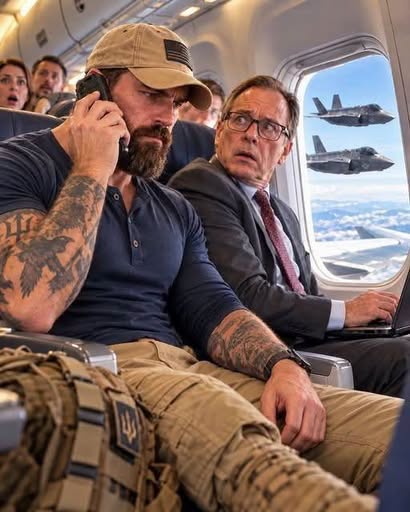
I glanced through the window.
The two F-35s had separated.
One remained beside us.
The other disappeared beneath the cloud layer.
“Are we being attacked?”“No.”
His answer came too quickly.
Then:
“Not yet.”
The executive beside me heard those words.
His face drained of color.
I lowered my voice.
“Who are they?”
“We don’t know.”
“You’re telling me the military doesn’t know who’s following a commercial flight?”
“We know who they claim to be.”
“And?”
A long silence.
“That’s the problem.”
The cabin lights flickered.
Once.
Twice.
Then returned to normal.
A few passengers laughed nervously.
The executive didn’t.
He was staring at me.
“You’re military,” he whispered.
I looked at him.
“Former military.”
“That’s why they’re here.”
“No.”
I looked through the window again.
The F-35 was still there.
But now I noticed something I hadn’t before.
It wasn’t escorting us.
It was watching us.
Specifically, the rear section of our aircraft.
I stood.
The flight attendant immediately stepped toward me.
“Sir, please remain seated.”
I showed her the phone.
“I need to speak with the captain.”
Her expression changed.
She looked at the screen.
Then at me.
“Sir…”
“Tell Captain Rodriguez that Hayes needs to see him.”
Her eyes widened.
“You’re Lieutenant Commander Hayes?”
I said nothing.
She hurried toward the cockpit.
The executive leaned closer.
“What is your name?”
I looked at him.
“Daniel.”
“Daniel what?”
I hesitated.
Then gave him the truth.
“Hayes.”
He stared at me.
His laptop slowly closed.
“You’re that Hayes?”
My stomach tightened.
“How do you know me?”
He swallowed.
“My company has contracts with the Department of Defense.”
“That doesn’t answer my question.”
“No.”
He looked toward the aisle.
“It doesn’t.”
Before I could press him, the aircraft suddenly banked.
Not dramatically.
Just enough.
But every instinct in my body recognized the maneuver.
I grabbed the seat.
The executive gripped the armrest.
The captain’s voice came over the intercom.
“Ladies and gentlemen, we’re experiencing a minor routing adjustment. Please remain calm.”
I looked outside.
The F-35 moved with us.
Then the radio crackled.
“Hayes.”
I froze.
The pilot’s voice came through again.
“Look at the man sitting beside you.”
I slowly turned.
The executive was staring at me.
The pilot continued.
“He isn’t who he says he is.”
My eyes locked with the executive’s.
For several seconds, neither of us moved.
Then his laptop chimed.
Once.
A message appeared on the screen.
I couldn’t read all of it.
But I saw three words.
PACKAGE CONFIRMED. HAYES ABOARD.
The executive slammed the laptop shut.
And that’s when I understood.
The fighter jets weren’t protecting the airplane.
They were protecting me.
Or perhaps protecting everyone else from whatever had followed me onto the plane.
I reached beneath my jacket.
The old scar across my ribs pulled painfully as I moved.
“Who are you?”
The executive didn’t answer.
Instead, he looked toward the ceiling.
Then he whispered:
“They found you.”
I felt the blood leave my face.
“Who?”
He looked directly into my eyes.
“The people who killed your team.”
Part 3 — The Medal
For a moment, the entire world became silent.
Not the airplane.
Not the passengers.
Not the engines.
Just me.
I heard Jake’s voice in my earpiece.
“Daniel?”
I couldn’t answer.
The executive stared at me.
“You said two brothers died in Syria.”
I slowly turned toward him.
“How do you know that?”
“I know more than you think.”
I stood.
This time, the flight attendant didn’t try to stop me.
Captain Rodriguez opened the cockpit door.
He looked at me for less than a second.
Then he nodded.
“Sir.”
I stepped inside.
The cockpit was dark except for the glow of the instruments.
Captain Rodriguez pointed toward the radar.
“Look.”
A small symbol was moving behind us.
It wasn’t another airliner.
It wasn’t military.
And it wasn’t broadcasting a recognizable identification signal.
“How long?”
“Twenty-three minutes.”
“Why didn’t you divert?”
“We tried.”
He pointed to another screen.
“Someone locked our flight plan.”
My jaw tightened.
“From where?”
He shook his head.
“Washington.”
Jake’s voice came through the encrypted phone.
“Daniel, listen to me.”
I put the phone on speaker.
“You have one job.”
“What?”
“Stay alive until you land.”
I almost laughed.
“That’s the plan?”
“No.”
His voice became softer.
“That’s the order.”
The radar screen suddenly changed.
The unidentified aircraft vanished.
Everyone in the cockpit stared at the screen.
Then the F-35 pilot spoke.
“Contact disappeared.”
I looked at Captain Rodriguez.
“Did it leave?”
“No.”
His face had gone pale.
“It just stopped transmitting.”
I knew what that meant.
I had seen it before.
Someone had deliberately gone dark.
The next forty minutes passed like hours.
The fighter jets remained with us.
The unidentified aircraft never returned to radar.
When we finally descended toward Washington, the cabin was completely silent.
Nobody knew what had really happened.
The passengers only knew that two fighters had escorted their airplane across the country.
When the wheels touched the runway, there were already military vehicles waiting beyond the terminal.
Not police.
Not airport security.
Military.
The doors opened.
And nobody came aboard.
Instead, one man stood at the bottom of the stairs.
White hair.
Admiral’s uniform.
He looked up at me.
“Lieutenant Commander Hayes.”
I stepped down.
“Admiral.”
He didn’t salute.
He simply looked at me for several seconds.
Then he said:
“You weren’t supposed to come back.”
I felt my throat tighten.
“Neither were my men.”
The Admiral looked away.
For the first time, I saw something in his eyes that wasn’t authority.
It was grief.
“You’re right.”
He reached into his jacket.
I expected another classified document.
Instead, he handed me a photograph.
I looked down.
Four men stood together in a desert valley.
My team.
Jake.
Miller.
Reed.
And me.
Taken three days before the operation.
I turned the photograph over.
There was writing on the back.
ONE OF THEM SURVIVED.
I looked up.
“Which one?”
The Admiral didn’t answer.
A black SUV pulled up beside us.
The rear door opened.
Jake stepped out.
For the first time in eight months, I saw my friend face-to-face.
He looked older.
Much older.
He walked toward me.
We didn’t shake hands.
We didn’t salute.
We just hugged.
Two soldiers who had spent too long pretending they weren’t broken.
Jake whispered:
“I’m sorry.”
I pulled away.
“For what?”
He looked at the photograph in my hand.
“Because I lied to you.”
My chest tightened.
“What did you lie about?”
He looked toward the terminal.
“The operation wasn’t a rescue mission.”
I stared at him.
“What was it?”
Jake swallowed.
“You weren’t sent there to rescue those hostages.”
“Then why were we there?”
His eyes met mine.
“You were sent there to retrieve something.”
“What?”
“A man.”
I felt the old scar in my leg begin to ache.
“Who?”
Jake’s executive voice dropped to a whisper.
“The executive sitting beside you.”
I turned.
But the executive was gone.
The terminal doors were closing behind him.
I took one step forward.
Jake grabbed my arm.
“Don’t.”
“Why?”
“Because if he wanted to disappear, he’d already be gone.”
I stared through the glass.
The man stopped.
For a moment, he turned toward me.
Then he raised one hand.
Not a wave.
A military signal.
One I hadn’t seen since my SEAL days.
Mission complete.
My heart pounded.
“Who is he?”
Jake looked at me.
“He was the reason your team was killed.”
I couldn’t breathe.
“And the reason you’re alive.”
That night, the Pentagon ceremony went ahead.
There were cameras.
Generals.
Politicians.
Handshakes.
Applause.
Someone read my citation.
I barely heard any of it.
When the medal was pinned to my chest, everyone stood.
I looked down at it.
Gold.
Heavy.
Beautiful.
And somehow meaningless.
Because the medal didn’t mention Miller.
It didn’t mention Reed.
It didn’t mention the helicopter that never came.
It didn’t mention the twelve minutes I spent trapped beneath concrete, listening to my best friend’s voice disappear over the radio.
It didn’t mention the man who had saved me.
Or the man who had betrayed us.
The applause eventually stopped.
The room became quiet.
The Admiral stepped toward the microphone.
“Lieutenant Commander Hayes has demonstrated extraordinary courage and sacrifice in service to his country.”
I looked across the room.
Jake was standing near the back.
He gave me the smallest nod.
I touched the medal.
Then I removed it.
Not dramatically.
Not angrily.
I simply placed it on the podium.
Everyone stared.
I picked up the photograph instead.
“The men who died that night deserve to be remembered,” I said.
My voice shook.
“But I don’t want anyone to remember me as a hero.”
The room was completely silent.
“I came home.”
I looked at Jake.
“They didn’t.”
I picked up the medal again.
And this time, I held it tightly.
Not because I wanted it.
But because I finally understood what it represented.
Not victory.
Not glory.
Not even courage.
It represented the weight of coming home when the people you loved didn’t.
Later that night, I walked alone through the Pentagon hallway.
My leg hurt.
My chest hurt.
But for the first time in years, I didn’t try to hide either.
I reached the exit.
My phone buzzed.
Unknown number.
One message.
YOU STILL HAVE ONE QUESTION.
I stopped.
Another message appeared.
WHO GAVE THE ORDER?
I stared at the screen.
Then came the final message.
ASK THE ADMIRAL.
I looked back toward the Pentagon.
The lights were still burning.
Somewhere inside that building were the answers I’d spent eight months trying not to remember.
I put the phone in my pocket.
And walked back inside.
Because sometimes coming home isn’t the end of the mission.
Sometimes it’s where the real mission begins.
Leave a Reply