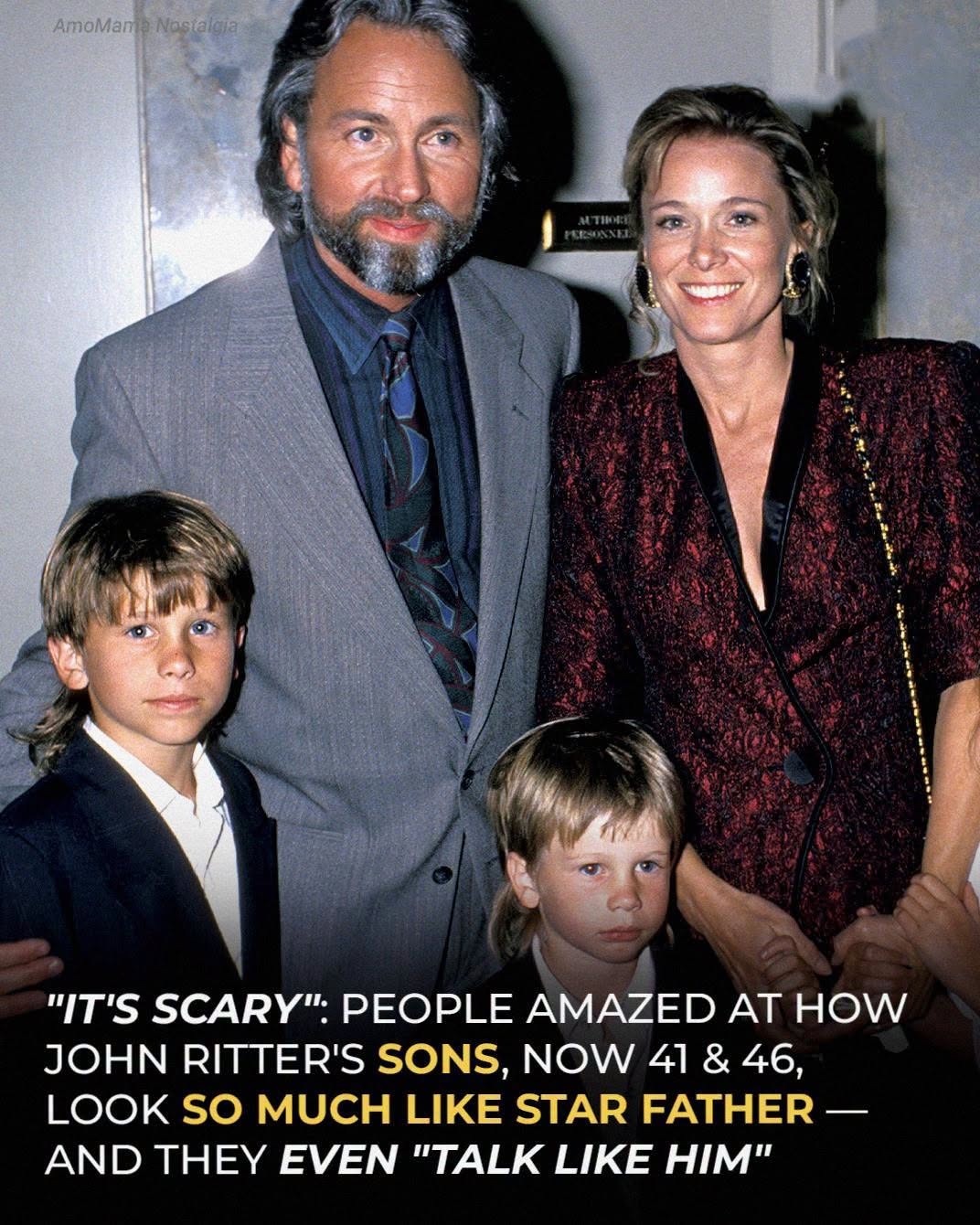
Few performers could turn a stumble, a raised eyebrow, or a perfectly timed pause into something unforgettable. But decades after the late icon last made audiences laugh, one discovery within his own family has given his story an unexpected and deeply consequential second chapter.
John Ritter spent decades making people laugh, but the story his family is telling about him today carries a far more serious message. Scroll through the photos that chart his extraordinary life and career, because the most haunting part of his legacy only becomes clear near the end.
1970: Before Jack Tripper Changed Everything
Long before audiences knew him as the accident-prone Jack Tripper, John grew up with show business quite literally in the family. According to his Biography profile, Jonathan Southworth Ritter was born on September 17, 1948, in Burbank, California, to Country Singer and Actor Tex Ritter and Actress Dorothy Fay
Southworth.
He and his older brother, Tom Ritter, grew up surrounded by entertainment, although John initially had no intention of following his famous parents into the business.
At the University of Southern California, he majored in psychology and minored in architecture. Everything changed after he was persuaded to join a drama class taught by Actress and Drama Coach Nina Foch. John switched to Theater Arts and eventually graduated in 1971 with a Bachelor of Fine Arts degree in drama.
Before that graduation even arrived, however, his career had already begun moving. From 1968 to 1969, he appeared in stage productions in Europe, including “Love Letters,” “The Glass Menagerie,” and “As You Like It.”
By 1970, John was already building the television résumé that would soon make him a familiar face, with appearances on “The Mary Tyler Moore Show” and “The Waltons.” Acting had replaced the psychology-and-architecture path he initially imagined for himself. | Source: Getty Images
By 1970, John was already building the television résumé that would soon make him a familiar face, with appearances on “The Mary Tyler Moore Show” and “The Waltons.” Acting had replaced the psychology-and-architecture path he initially imagined for himself. | Source: Getty Images
Back in the United States, John continued appearing on major shows, including “Hawaii Five-O” in 1971 and “M.A.S.H.” in 1973. While his professional life was gathering speed, his personal life was beginning an important chapter, too.
This image came roughly two years before John and Nancy Morgan married in 1977. Their marriage would last until 1996 and produce three children, Jason, Tyler, and Carly. | Source: Getty Images
Then came the role that transformed John from a steadily working actor into a television star.
1977: The Role That Made Him a Household Name
In 1977, John landed the part of Jack Tripper on ABC’s “Three’s Company.” The setup followed three singles sharing an apartment, but John’s gift for physical comedy quickly became one of the show’s defining ingredients. His goofy, accident-prone Jack became the sort of character audiences could recognize almost instantly.
The year 1977 marked the beginning of the role that would become inseparable from John’s name. Jack Tripper turned his comic timing and physical humor into television trademarks. | Source: Getty Images
The year 1977 marked the beginning of the role that would become inseparable from John’s name. Jack Tripper turned his comic timing and physical humor into television trademarks. | Source: Getty Images
Success on “Three’s Company” coincided with major developments away from the screen. John married Nancy Morgan in 1977, and that same year, he and his brother Tom began hosting the annual United Cerebral Palsy telethon. Biography notes that Tom had triumphed over cerebral palsy, and the brothers helped raise millions of dollars for the organization over the years.
1978
By 1978, John was balancing a rapidly expanding television career with life as a newly married man. His relationship with Nancy would span nearly two decades as his fame continued to climb. | Source: Getty Images
By 1978, John was balancing a rapidly expanding television career with life as a newly married man. His relationship with Nancy would span nearly two decades as his fame continued to climb. | Source: Getty Images
The popularity of “Three’s Company” kept growing, and so did John’s reputation as someone who could turn even the smallest movement, pause, or reaction into a joke.
1979
John was firmly established as one of television comedy’s most recognizable performers by the end of the 1970s. Jack Tripper gave him the perfect vehicle for the physical humor that became his calling card. | Source: Getty Images
John was firmly established as one of television comedy’s most recognizable performers by the end of the 1970s. Jack Tripper gave him the perfect vehicle for the physical humor that became his calling card. | Source: Getty Images
1980
As “Three’s Company” rolled into a new decade, John’s popularity showed little sign of slowing. The series ultimately ran from 1977 to 1984, giving him years to refine the frantic but warmhearted comedy audiences loved. | Source: Getty Images
As “Three’s Company” rolled into a new decade, John’s popularity showed little sign of slowing. The series ultimately ran from 1977 to 1984, giving him years to refine the frantic but warmhearted comedy audiences loved. | Source: Getty Images
The acclaim was not limited to viewers. John’s Television Academy profile records six Primetime Emmy nominations and one win over the course of his career, with nomination years spanning from 1978 through a posthumous nod in 2004.
1981
By 1981, Jack Tripper was already a defining character in John’s career. The Television Academy lists that year among those in which the actor received Emmy recognition. | Source: Getty Images
By 1981, Jack Tripper was already a defining character in John’s career. The Television Academy lists that year among those in which the actor received Emmy recognition. | Source: Getty Images
1982
John’s comic appeal rested on more than pratfalls, with his warmth helping keep Jack Tripper from becoming merely a collection of jokes. That combination would continue shaping the roles he chose after “Three’s Company.” | Source: Getty Images
John’s comic appeal rested on more than pratfalls, with his warmth helping keep Jack Tripper from becoming merely a collection of jokes. That combination would continue shaping the roles he chose after “Three’s Company.” | Source: Getty Images
1983
John entered the mid-1980s with major awards recognition attached to the role that had made him famous. Yet rather than remain frozen in one sitcom identity, he was already preparing for what came next. | Source: Getty Images
John entered the mid-1980s with major awards recognition attached to the role that had made him famous. Yet rather than remain frozen in one sitcom identity, he was already preparing for what came next. | Source: Getty Images
1984: Life After ‘Three’s Company’
By 1984, the same year the popular sitcom came to an end, his performance had earned him both a Golden Globe and a Primetime Emmy. The end of “Three’s Company” in 1984 did not mean John was finished with Jack Tripper.
He briefly reprised the character in the spin-off “Three’s a Crowd,” which aired for one season. That same year, he formed his own production company, Adam Productions.
The year 1984 closed one enormous chapter for John while opening another behind the scenes. With “Three’s Company” ending, he was moving toward producing as well as performing. | Source: Getty Images
The year 1984 closed one enormous chapter for John while opening another behind the scenes. With “Three’s Company” ending, he was moving toward producing as well as performing. | Source: Getty Images
Through Adam Productions, John later produced and starred in the comedy-drama “Hooperman,” earning critical acclaim.
1985
After eight seasons associated with Jack Tripper, John faced the difficult task of proving there was much more to him than one beloved character. His next phase would stretch across television, film, producing, and eventually Broadway. | Source: Getty Images
After eight seasons associated with Jack Tripper, John faced the difficult task of proving there was much more to him than one beloved character. His next phase would stretch across television, film, producing, and eventually Broadway. | Source: Getty Images
1987
John kept moving between projects rather than trying to recreate “Three’s Company” indefinitely. That willingness to shift genres would become a major feature of his post-Jack career. | Source: Getty Images
John kept moving between projects rather than trying to recreate “Three’s Company” indefinitely. That willingness to shift genres would become a major feature of his post-Jack career. | Source: Getty Images
1988
The big screen also allowed him to lean into the physical comedy audiences already knew he could deliver. In 1987, he appeared in “Real Men.”
By 1987, John was widening his film career with comedies such as “Real Men.” His marriage to Nancy remained part of his life as he continued moving between television and movies. | Source: Getty Images
By 1987, John was widening his film career with comedies such as “Real Men.” His marriage to Nancy remained part of his life as he continued moving between television and movies. | Source: Getty Images
1989
The Television Academy lists 1988 among John’s Emmy nomination years, evidence that his awards recognition continued after the height of “Three’s Company.” His career was proving considerably broader than the sitcom that first made him a star. | Source: Getty Images
The Television Academy lists 1988 among John’s Emmy nomination years, evidence that his awards recognition continued after the height of “Three’s Company.” His career was proving considerably broader than the sitcom that first made him a star. | Source: Getty Images
John entered the 1990s with a career that was still evolving rather than settling into nostalgia. Major screen roles in “It” and the “Problem Child” films were just ahead. | Source: Getty Images
John entered the 1990s with a career that was still evolving rather than settling into nostalgia. Major screen roles in “It” and the “Problem Child” films were just ahead. | Source: Getty Images
His range became particularly clear as the 1990s approached. In 1990, Ritter portrayed the adult Ben Hanscom in “It,” adding another very different credit to an increasingly varied résumé. He also played Ben Healy in “Problem Child” in 1990 and returned for “Problem Child 2” in 1991.
1992
By the early 1990s, John had moved through sitcom stardom, film comedy, drama, and television work without losing the approachable quality audiences associated with him. His screen résumé would eventually grow to more than 100 film and television appearances combined. | Source: Getty Images
1994
John’s ability to remain playful in public mirrored the comic energy that had defined so many of his performances. Years later, his sons would describe just how genuine that joy was when the cameras stopped rolling. | Source: Getty Images
John’s ability to remain playful in public mirrored the comic energy that had defined so many of his performances. Years later, his sons would describe just how genuine that joy was when the cameras stopped rolling. | Source: Getty Images
1996: A Changing Personal Life and a Career That Kept Growing
John and Nancy’s marriage ended in 1996 after nearly two decades. The family chapter that began with their 1977 wedding had brought John three of his four children, Jason, Tyler, and Carly Ritter, and those children would later become important custodians of both his memory and the health message attached to his death.
The year 1996 brought a major personal transition as John’s marriage to Nancy came to an end. Professionally, however, he remained an active and familiar presence across television and film. | Source: Getty Images
The year 1996 brought a major personal transition as John’s marriage to Nancy came to an end. Professionally, however, he remained an active and familiar presence across television and film. | Source: Getty Images
Even after decades in entertainment, John’s playful streak remained central to his public persona. It was the same quality colleagues and family members would later remember with particular affection. | Source: Getty Images
Even after decades in entertainment, John’s playful streak remained central to his public persona. It was the same quality colleagues and family members would later remember with particular affection. | Source: Getty Images
1998
Two years later, in 1998, John welcomed his fourth child, Noah Ritter, with Actress Amy Yasbeck. John and Amy got married in 1999.
John became a father for the fourth time in 1998 with the birth of Noah. Family would take on even greater significance in the final years of his life. | Source: Getty Images
John became a father for the fourth time in 1998 with the birth of Noah. Family would take on even greater significance in the final years of his life. | Source: Getty Images
2000
The new millennium brought another role that introduced John’s voice to a younger generation. From 2000 to 2003, he voiced the title character in PBS’s “Clifford the Big Red Dog,” earning four Daytime Emmy Award nominations for the work.
John entered the 2000s with a career that was still finding new audiences. His work as Clifford showed that his warmth could translate even when viewers never saw him on screen. | Source: Getty Images
John entered the 2000s with a career that was still finding new audiences. His work as Clifford showed that his warmth could translate even when viewers never saw him on screen. | Source: Getty Images
2001
Broadway then followed. In 2001, John received the Theatre World Award for his performance in “The Dinner Party.”
The 2001 Theatre World Award added another dimension to a career already packed with television and film credits. John was still collecting new achievements more than three decades after his earliest screen appearances. | Source: Getty Images
The 2001 Theatre World Award added another dimension to a career already packed with television and film credits. John was still collecting new achievements more than three decades after his earliest screen appearances. | Source: Getty Images
2002: One More Sitcom, and the Joy His Sons, Jason and Tyler, Still Remember
In 2002, John returned to weekly television in “8 Simple Rules for Dating My Teenage Daughter,” starring alongside Kaley Cuoco and Katey Sagal. The role of Paul Hennessy would become his final sitcom performance, but according to his sons, it also showed their father exactly where he seemed happiest.
By 2002, John had been married to Amy for three years and was raising his youngest child while beginning another major television chapter. “8 Simple Rules” put him back inside the sitcom environment he adored. | Source: Getty Images
By 2002, John had been married to Amy for three years and was raising his youngest child while beginning another major television chapter. “8 Simple Rules” put him back inside the sitcom environment he adored. | Source: Getty Images
The esteem in which other comedians held him was hardly a secret either. According to the Television Academy, Don Knotts called John the “greatest physical comedian on the planet” in 2002.
That recollection became especially moving years later when Jason and Tyler, who both followed their dad into the entertainment industry as actors, discussed their father’s work in a recent Pause Rewind interview.
Asked which of their father’s roles stood out most, Jason admitted he had plenty to choose from. “Oh my gosh. I have a bunch. I really have a bunch,” he said. Still, Jason ultimately singled out “Sling Blade” and “Skin Deep,” saying, “Those two performances are two of my favourites.”
Tyler also had a special attachment to “Skin Deep,” partly because he had to wait until he was old enough to watch it. Once he finally did, he said it became one of his all-time favorite movies, with several of his father’s scenes standing out as “amazing and brilliant.” But Jason said watching his father as Jack Tripper, and later on “8 Simple Rules,” offered something different.
John’s willingness to look silly was never incidental to his comedy; it was one of his greatest strengths. His sons later remembered that making people laugh brought him genuine happiness both during scenes and between takes. | Source: Getty Images
John’s willingness to look silly was never incidental to his comedy; it was one of his greatest strengths. His sons later remembered that making people laugh brought him genuine happiness both during scenes and between takes. | Source: Getty Images
He recalled visiting the “8 Simple Rules” set when he was younger and seeing just how naturally John fit into the sitcom environment. Jason remembered his father being “so on fire” and said he genuinely loved making people laugh even when the cameras were not rolling.
He also pointed fans toward “8 Simple Rules” bloopers, calling them one of his “internet happy places” because they offer a glimpse of what John was like between takes. For John, Jason explained, a sitcom meant having a platform to make people laugh, build a little family, and essentially perform a new play every week. “He just loved it so much,” Jason shared.
John’s return to a family sitcom proved that his comic rhythm still connected with audiences decades after Jack Tripper. His work as Paul Hennessy would later bring him a posthumous Emmy nomination. | Source: Getty Images
John’s return to a family sitcom proved that his comic rhythm still connected with audiences decades after Jack Tripper. His work as Paul Hennessy would later bring him a posthumous Emmy nomination. | Source: Getty Images
2003: The Final Year
John’s final live-action film was “Bad Santa,” while “Clifford’s Really Big Movie” became one of his last projects. Both were later dedicated to his memory.
John entered 2003 still working steadily, with “8 Simple Rules” anchoring his television career and other projects continuing around it. No one knew that the year would become his last. | Source: Getty Images
John entered 2003 still working steadily, with “8 Simple Rules” anchoring his television career and other projects continuing around it. No one knew that the year would become his last. | Source: Getty Images
John remained professionally active right up to the final months of his life. His last projects would soon carry dedications honoring the performer audiences had watched for more than three decades. | Source: Getty Images
John remained professionally active right up to the final months of his life. His last projects would soon carry dedications honoring the performer audiences had watched for more than three decades. | Source: Getty Images
On September 11, 2003, John became ill while working on “8 Simple Rules.” He experienced chest pain, nausea, and vomiting and was taken to a hospital across the street from the Burbank studio. He died several hours later at just 54 from a torn aorta.
The Los Angeles Times later noted one especially heartbreaking detail: John died on his youngest child’s (then-daughter) fifth birthday.
John’s death at 54 abruptly ended a career that was still very much in motion. The medical circumstances surrounding those final hours would later push his family toward a mission much larger than preserving his entertainment legacy. | Source: Getty Images
John’s death at 54 abruptly ended a career that was still very much in motion. The medical circumstances surrounding those final hours would later push his family toward a mission much larger than preserving his entertainment legacy. | Source: Getty Images
The following year, John was nominated posthumously for an Emmy for “8 Simple Rules.” The series continued for two more seasons before ending in 2005. Shortly after his death, the television industry paid tribute to him.
John was remembered at the 2003 Primetime Emmy Awards only days after his sudden death. The tribute underscored just how abruptly television had lost one of its most familiar comic performers. | Source: Getty Images
John was remembered at the 2003 Primetime Emmy Awards only days after his sudden death. The tribute underscored just how abruptly television had lost one of its most familiar comic performers. | Source: Getty Images
But what happened medically that day would become the part of John’s story his family most urgently wants people to understand.
The Diagnosis Doctors Did Not Initially See
More than two decades later, on September 17, 2026, what would have been John’s 78th birthday, his family once again spoke publicly about the condition that killed him. According to the New York Post, John’s loved ones are working to increase awareness of aortic dissection, a medical emergency involving the body’s largest artery.
When John arrived at the hospital in September 2003 sweating heavily, vomiting, and experiencing chest pain, doctors initially believed he was having a heart attack. His widow, Amy, said the assumption reflected how much more commonly physicians encounter cardiac symptoms that appear to point toward a heart attack.
John was a father of four, with Jason, Tyler, and Carly from his marriage to Nancy Morgan and Noah with Amy Yasbeck. Family would later become a central part of both his personal legacy and the health campaign created after his death. | Source: Getty Images
John was a father of four, with Jason, Tyler, and Carly from his marriage to Nancy Morgan and Noah with Amy Yasbeck. Family would later become a central part of both his personal legacy and the health campaign created after his death. | Source: Getty Images
Read also
Leave a Reply